
A coil fails in a fifteen-year-old chiller. The OEM has discontinued the model, the spare is unavailable, or the quoted price and lead time make replacing the whole machine look reasonable — which is precisely the outcome the quotation was designed to produce.
This situation is far more common than the equipment market admits, and it has a straightforward answer: a coil is a made-to-order product. Any competent fin-and-tube manufacturer can build a replacement to the original envelope, whether or not the original supplier still exists.
Here is how to make that happen without a second failure.
Step 1: Capture the Coil Before It Leaves the Machine
Once the old coil is out and scrapped, the information goes with it. Capture everything while it is still in place.
Measure and record:
- Finned height and finned length
- Finned depth, and overall depth including headers
- Number of rows
- Fin density — count fins across a measured inch and count carefully; this is the number most often recorded wrong
- Tube outer diameter
- Tube pattern and spacing
- Connection sizes
- Connection positions, dimensioned from a fixed datum on the frame
- Frame dimensions, flange positions and every mounting hole with its centres
- Overall envelope including anything that protrudes
Photograph:
- The full coil face, square on
- Both headers, close up, showing every connection
- The tube pattern at the coil end, close enough to count rows and see the staggering
- Any nameplate, stamp, marking or label anywhere on the coil or frame
- The coil in position in the equipment, before removal — this is the photograph that answers questions nobody has thought to ask yet
- Any distributor, and its nozzle if visible
Collect:
- Equipment make, model and serial number
- Refrigerant or fluid, and the charge
- Operating conditions if the machine is instrumented
- The original drawing, if it exists anywhere
Ten minutes with a tape measure and a phone camera at removal saves a fortnight of correspondence later.
Step 2: Decide What Not to Copy
This is the part most people skip, and it is where the real value is.
The failed coil is evidence. It ran in your actual environment under your actual conditions, and how it failed tells you what the original specification got wrong. Copying it exactly means reproducing that error and scheduling the same failure again.
Ask what killed it:
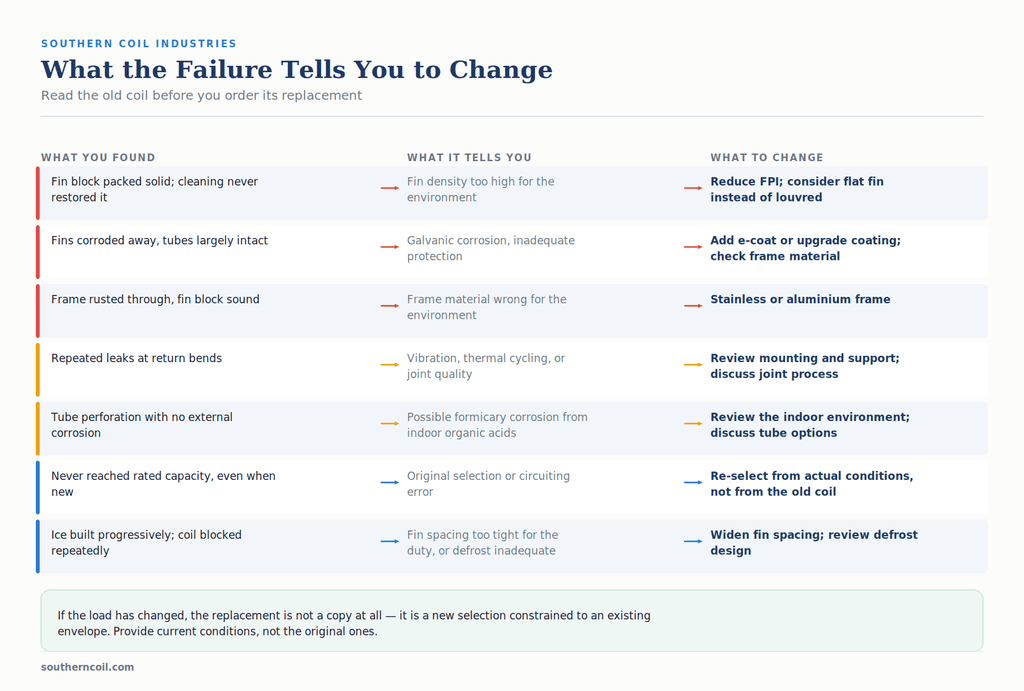
A replacement coil is a rare opportunity to fix a specification decision that has been costing you money for a decade. Take it.
Step 3: Decide How Faithful the Copy Needs to Be
Not everything has to match. Sort the parameters into three groups.

Must match exactly — these are what make it fit:
- Overall envelope and mounting dimensions
- Mounting hole positions
- Connection positions and orientation
- Connection sizes, unless you are prepared to modify pipework
Should match unless there is a reason to change:
- Duty
- Tube diameter
- Row count
- Circuit count
Should be reconsidered every time:
- Fin density
- Fin geometry
- Coating and corrosion protection
- Frame material
- Fastener material
- Tube type — plain versus inner-grooved
That last one is worth a sentence. If the original coil was plain tube and the envelope is fixed, switching to inner-grooved tube can recover duty that the original design left on the table — useful when the load has grown since the equipment was installed but the space has not.
Step 4: When the Load Has Changed
Equipment frequently outlives the application it was bought for. The cold room now holds a different
product, the process line runs faster, the building gained a floor.
If the load has changed, the replacement is not a copy at all — it is a new selection constrained to an existing envelope. Provide the current operating conditions, not the original ones, and state the envelope as the hard constraint it is.
Within a fixed envelope, the levers available are: fin density, fin geometry, row count where depth allows, tube type, and circuiting. Between them there is usually more range than people expect — a fixed-envelope redesign can often recover 10 to 20% more duty than the original, particularly if the original was a standard product rather than a designed one.
Step 5: What to Send the Manufacturer
Send everything you captured in Step 1 plus:
- What failed, and how — with the photographs
- How long it lasted
- The environment it lived in
- What the equipment does now, if it has changed
- Whether you want a like-for-like copy or an improved specification
- Whether the machine is down (this changes how the enquiry is handled)
Say explicitly if the equipment is out of service. A replacement coil for a running machine and a replacement coil for a plant that is stopped are the same product with entirely different urgency, and manufacturers schedule accordingly.
What If There Is No Old Coil?
Sometimes the coil is already gone, or was destroyed in the failure. It is still workable, from any of:
- The equipment nameplate and model number
- The equipment manufacturer’s technical documentation
- The space the coil occupied, measured directly
- The pipework connections left behind — position, size and orientation
- A photograph from before removal, even a poor one
- A sister unit, if there is an identical machine on site
An identical machine on site is the best possible source. Measure and photograph that one.
The Common Objections
“It won’t be as good as the original.” It can readily be better. The original was designed to a price for a general market. A replacement is designed for your actual conditions, in an envelope that is already known to fit, with the benefit of knowing how the first one failed
“It’ll take too long.” Compare it honestly against the lead time for the OEM spare, or for a whole new machine. A custom coil is usually the faster route, not the slower one.
“It’s cheaper to replace the unit.” Occasionally true, particularly if the machine is at end of life across all its components or the refrigerant is being phased out anyway. Usually not, when the coil is the only failed component in an otherwise sound machine.
That last caveat is worth taking seriously in one specific case: if the machine runs R22 or a high-GWP HFC and you are planning a refrigerant transition anyway, a failed coil may be the right moment to change the machine rather than the coil. See Article 6.
Replacing a coil that is no longer available?
Send Southern Coil Industries the dimensions, photographs and whatever you know about the failure. We manufacture replacement fin-and-tube coils from 6 inches to 6 metres and beyond, built to the original envelope — and we will tell you what we would specify differently.