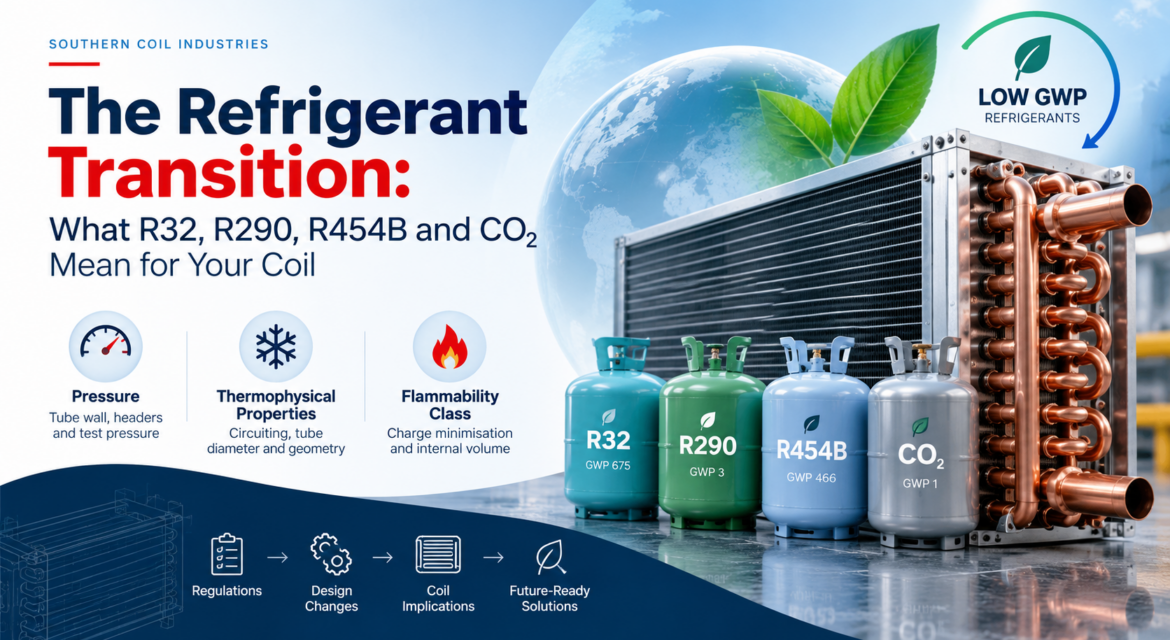
India’s refrigerant landscape is changing on a fixed schedule, and the change reaches the coil earlier than most people expect.
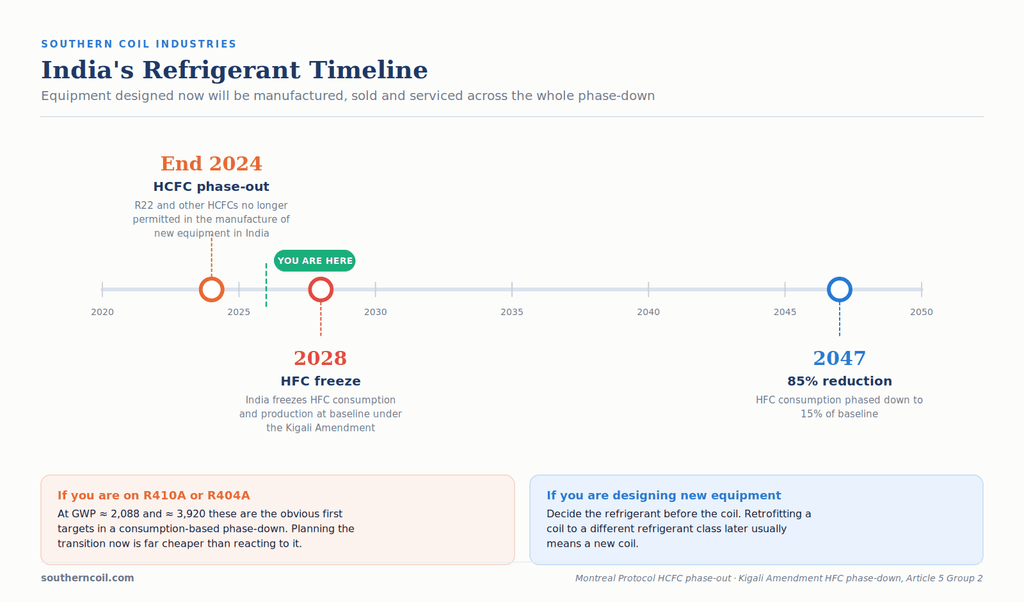
Under the Montreal Protocol’s HCFC phase-out, India ended the use of HCFCs including R22 in the manufacture of new equipment at the end of 2024. Under the Kigali Amendment, India freezes HFC consumption and production in 2028 and phases down to 15% of baseline by 2047.
For an OEM, that means equipment being designed now will be manufactured, sold and serviced across the entire phase-down period. The refrigerant decision made today determines what the coil has to be built for — and a coil designed for the wrong refrigerant is not a coil that can be adjusted later.
Here is what actually changes in the heat exchanger
The Short Answer
Three things change, and they change independently of each other:
- Pressure — which drives tube wall thickness, header design and test pressure
- Thermophysical properties — which drive circuiting, tube diameter and coil geometry
- Flammability class — which drives charge minimisation, and therefore internal volume
A coil designed for one refrigerant and used with another may be unsafe, undersized, or both.
Pressure: The Constraint That Cannot Be Worked Around
Refrigerants operate at very different pressures, and the coil’s design working pressure has to suit.
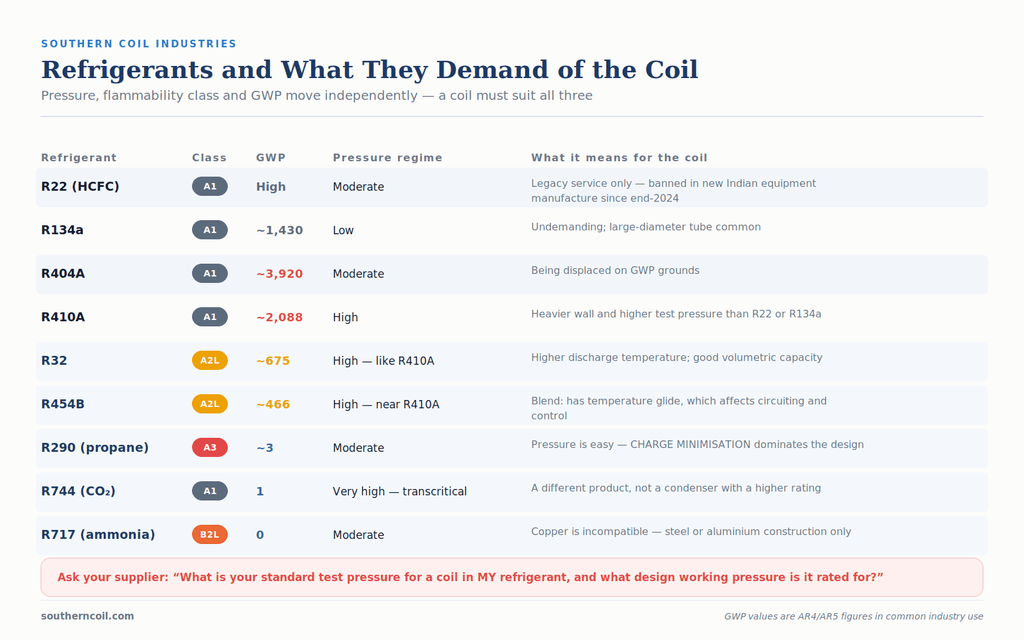
Two entries deserve emphasis.
CO₂ is not a variation on a standard coil. Transcritical CO₂ systems operate at pressures several times those of conventional HFC systems. This is not a matter of specifying a heavier wall on a standard tube — it requires different tube sizing, different wall thickness, different header construction and a different test regime throughout. Treat a CO₂ gas cooler as a distinct product, not as a condenser with a higher pressure rating.
Ammonia and copper do not mix. Ammonia attacks copper and copper alloys aggressively. Any ammonia duty requires steel or aluminium construction. This is absolute, not a matter of degree
Flammability: Why A2L and A3 Change the Coil Itself
R32 and R454B are A2L — mildly flammable. R290 is A3 — higher flammability. Ammonia is B2L — mildly flammable and toxic
Safety standards limit the permissible refrigerant charge in an appliance based on the refrigerant, the room volume and the equipment type. Those limits have been under active revision — the IEC has approved increases to hydrocarbon charge limits for household air conditioners and heat pumps — but a limit still applies, and for R290 in particular it is restrictive.
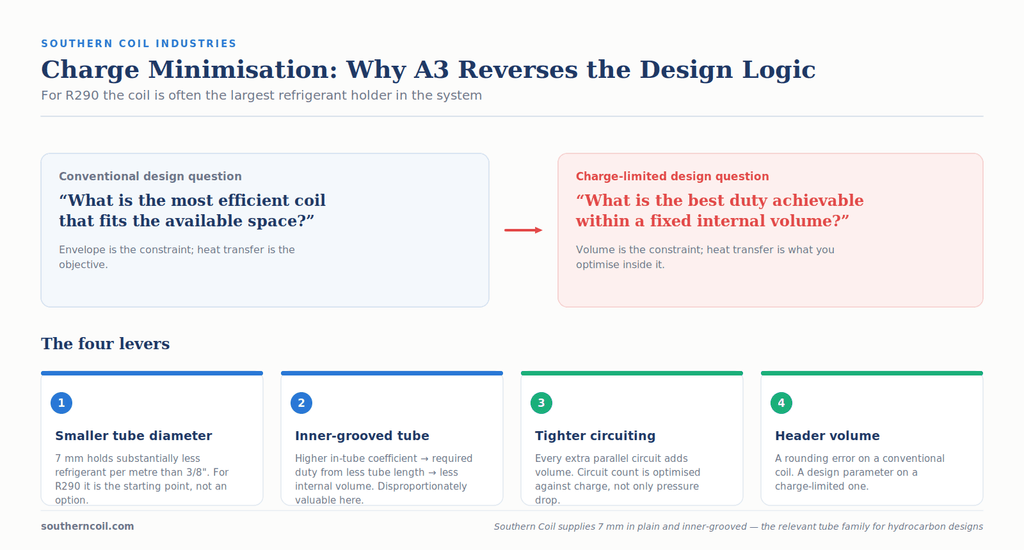
This has a direct and often surprising consequence for the coil: the heat exchanger is frequently the largest single holder of refrigerant in the system. If the charge limit is the binding constraint, the coil’s internal volume becomes a primary design parameter — sometimes more important than its heat transfer performance.
That reverses the usual design logic. Instead of “what is the most efficient coil that fits the space”, the question becomes “what is the best duty achievable within a fixed internal volume.”
The design responses:
- Smaller tube diameter. 7 mm holds substantially less refrigerant per metre than 3/8″, and 3/8″ less than 1/2″. For an R290 duty, 7 mm is usually the starting point rather than an option.
- Inner-grooved tube. Higher in-tube heat transfer coefficient means the required duty is achieved with less tube length, which means less internal volume. Inner-grooved tube is disproportionately valuable in
charge-limited designs. - Tighter circuiting discipline. Every extra parallel circuit adds volume. Circuit count has to be optimised against charge rather than just pressure drop.
- Header volume matters. On a conventional coil header volume is a rounding error. On a charge-limited R290 coil it is a design parameter.
Southern Coil manufactures 7 mm in both plain and inner-grooved, which is the relevant tube family for charge-minimised hydrocarbon designs.
Thermophysical Properties: Why the Same Coil Performs Differently
Beyond pressure and flammability, refrigerants differ in latent heat, density, viscosity and heat transfer coefficient. Swapping refrigerant in an unchanged coil changes its performance, and not always in the obvious direction.
R32 has notably high volumetric capacity and good heat transfer characteristics — it can often deliver equivalent duty from less coil. Its drawback is discharge temperature: R32 runs hotter at the compressor discharge than R410A, which affects the condenser inlet condition and the system components around it more than the coil itself.
R454B is a blend designed to approximate R410A’s behaviour at roughly a fifth of the GWP, which makes it attractive for equipment platforms that would otherwise need redesign. Being a blend, it has a temperature glide — the evaporating and condensing temperatures are not constant through the phase change. Glide affects circuiting and control, and it means a blend is not a like-for-like substitution for a single-component refrigerant even when the pressures match.
R290 has excellent thermodynamic properties and a very low GWP. In pure heat-transfer terms it is a good refrigerant. Everything difficult about designing for it comes from the charge limit, not from its performance.
Glide: The Blend Complication
Any zeotropic blend — R454B, R407C, R448A, R449A and others — exhibits temperature glide. The refrigerant does not evaporate or condense at a single temperature; it moves through a range.
This matters for coil design because:
- Counter-flow arrangement becomes more valuable, since it allows the glide to work with the airtemperature profile rather than against it
- Circuiting must account for the changing temperature along the circuit
- Superheat control behaves differently, which affects how the coil is fed
- A coil designed for a single-component refrigerant and applied to a glide refrigerant will not perform to its original rating
If you are specifying a coil for a blend, say so explicitly and state the glide. It is not a detail.
What This Means If You Are an OEM Right Now
If you are designing new equipment, decide the refrigerant before the coil, and design the coil for it. Retrofitting a coil to a different refrigerant class later usually means a new coil
If you are running an R22 legacy fleet, new equipment manufacture with R22 ended in India at the end of 2024. Replacement coils for existing R22 systems remain a legitimate requirement — that is servicing, not new manufacture — but any new platform needs a different refrigerant.
If you are on R410A or R404A, the phase-down clock is running. R410A at GWP ~2,088 and R404A at ~3,920 are the obvious first targets in any consumption-based phase-down. Planning the transition now is considerably cheaper than reacting to it in 2028.
If you are considering R290, engage the coil manufacturer early. Charge minimisation is a coil-level design problem, and it cannot be solved after the rest of the system is fixed.
If you are considering CO₂, treat it as a separate development programme with a specialist. It is not an incremental change
The Question to Ask Your Coil Supplier
Ask this one, in these words:
“What is your standard test pressure for a coil in [my refrigerant] service, and what design working pressure is that coil rated for?”
A general test pressure figure quoted without reference to a refrigerant is not an answer. The number only means something relative to what the coil will actually see
Planning a refrigerant transition?
Southern Coil Industries manufactures customised fin-and-tube heat exchangers in 7 mm, 3/8″ and 1/2″ tube, plain and inner-grooved, for refrigeration, air conditioning, heat pump and industrial applications. Tell us the refrigerant and the constraint — pressure, charge, or envelope — and we will design around it.