A coil is an assembly of dissimilar metals with an enormous surface area, permanently exposed to whatever is in the air, and frequently wet. It is close to a purpose-built corrosion experiment.
In a clean, dry, inland installation this does not matter much. Within a few kilometres of the coast, in a chemical plant, or in an evaporator running constantly wet, it becomes the factor that determines whether the coil lasts fifteen years or three.
Why Coils Corrode Faster Than the Equipment Around Them
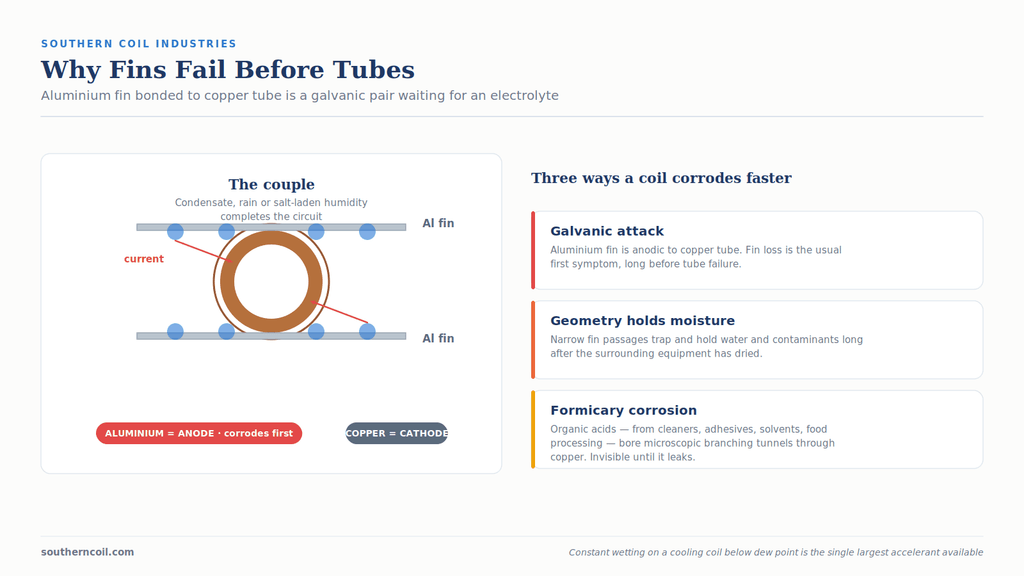
Galvanic coupling. Aluminium fin mechanically bonded to copper tube is a galvanic pair. Introduce an electrolyte — condensate, rain, salt-laden humidity — and current flows. The aluminium fin is anodic to the copper and corrodes preferentially. This is why fin degradation typically precedes tube failure, and why fin loss is the usual first symptom.
Surface area and geometry. The fin block presents an enormous surface with narrow passages that trap and hold moisture and contaminants long after the surrounding equipment has dried.
Constant wetting. A cooling coil below dew point is wet whenever it runs. Continuous moisture is the single largest accelerant available.
Formicary corrosion. In the presence of certain organic acids — from cleaning products, adhesives, solvents, some building materials and food processing — copper tube develops microscopic branching tunnels that eventually perforate the wall. It is invisible until the coil leaks, and it is a recognised cause of premature copper tube failure in indoor coils, particularly in new buildings where off-gassing is high.
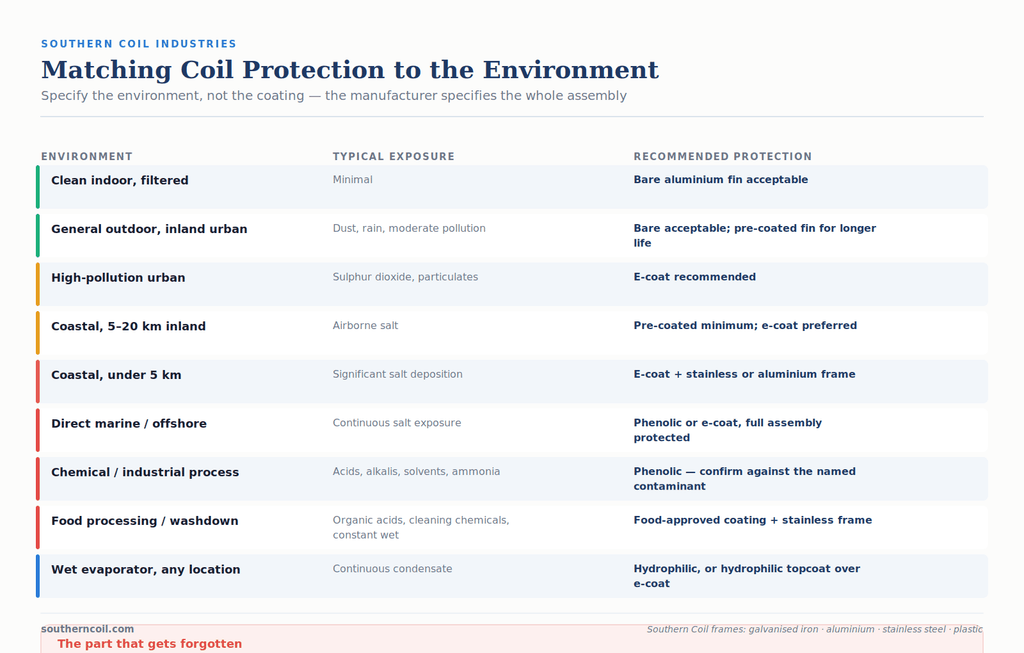
The Options, Honestly Compared
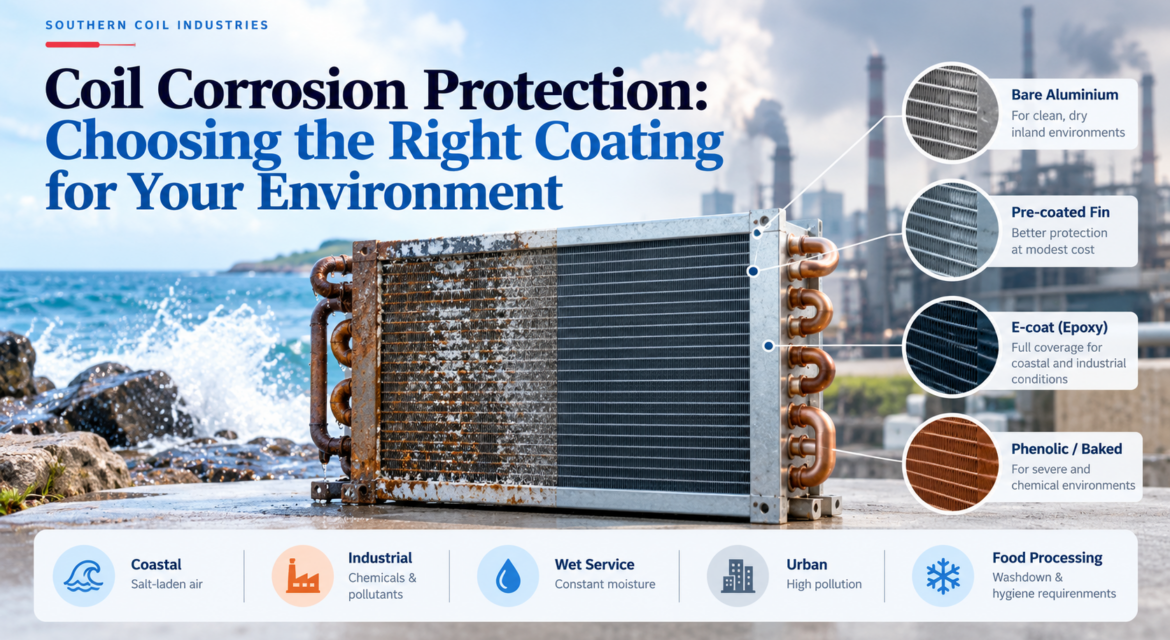
Bare aluminium fin, copper tube
The default. Perfectly adequate indoors and in benign outdoor locations, and the highest heat transfer of any option because there is no coating layer between metal and air
Use it when: the environment is genuinely mild. Do not use it when: the coil is within a few kilometres of the coast, in an industrial atmosphere, or in a high-pollution urban setting.
Pre-coated fin stock
Fin material coated before the fin is pressed. Because the coating is applied to flat stock in a controlled process, coverage on the flat surfaces is uniform and the cost is low.
Typical pre-coated fin stock is rated in the region of 1,000 hours ASTM B117 salt spray — a meaningful improvement over bare aluminium at modest cost.
The limitation is inherent to the process: the fin is coated before it is formed, so the cut edges created when the fin is pressed are bare, as is the collar where it contacts the tube. Protection is therefore good on the fin face and weaker precisely at the edges and the galvanic junction — which is where attack starts.
Use it when: you need better-than-bare protection at low cost in a mild-to-moderate environment. Hydrophilic pre-coated fin is the standard choice for wet evaporator duty in a non-aggressive setting.
E-coat (epoxy electrocoat)
The assembled coil is immersed and an electrical potential deposits an epoxy film over every wetted surface — fin faces, fin edges, collars, tubes, and the fin-tube junction — followed by a bake cure. Because deposition is electrochemical rather than line-of-sight, it reaches into the fin block in a way that sprayed coatings cannot.
E-coat systems are typically rated in the region of several thousand hours ASTM B117, with quality systems cited at 6,000 hours or more — a substantial step up from pre-coated fin.
Trade-offs to be aware of:
- A thermal penalty. The coating adds a resistance layer. It is modest — typically a low single-digit percentage — but real, and it should be accounted for in selection rather than ignored.
- It is hydrophobic. Standard e-coat causes water to bead rather than sheet, which is unhelpful on a wet evaporator. Where both corrosion protection and drainage are needed, a hydrophilic topcoat over the e-coat is the correct specification — it retains the protection while restoring sheeting drainage, at small additional cost.
- Cost and lead time. Higher than pre-coated fin on both counts.
Use it when: the coil is coastal, industrial, or high-pollution urban, and expected to last.
Sprayed epoxy
The most widely offered corrosion protection in the Indian market, and the usual middle option between precoated fin and e-coat. The assembled coil is spray-coated with an epoxy system and cured. Its strength is cost and availability, and on the exposed faces of the fin block it gives real protection against humid, coastal and industrial air. Its limitation is inherent to the application method: spray is line-of-sight, so coverage deep inside a dense fin pack, on the fin collars and at the fin-to-tube junction is less complete than an immersion process can achieve. The more rows and the higher the fin density, the more pronounced that difference becomes
Use it when: you need meaningful corrosion protection at sensible cost in a humid, coastal or moderately industrial environment, particularly on coils of low to moderate fin density where spray can reach through the block. Be aware of its limits when: the coil is dense and deep, or the environment is severe enough that protection at the fin-tube junction is the deciding factor
Fin density and coating choice interact here, and that is worth saying plainly: a lower fin density is easier to coat properly by spray. In an aggressive environment, specifying 8–10 FPI instead of 14 FPI improves both fouling resistance and coating coverage at the same time.
Phenolic and baked coatings
Heavier-duty chemistry for severely corrosive service — marine, offshore, chemical process, and applications requiring approval for food-adjacent zones. Higher chemical resistance than epoxy, particularly against specific aggressive agents, at higher cost, longer lead time, and a somewhat larger thermal penalty.
Use it when: the environment is genuinely severe, or a specific chemical exposure has been identified that epoxy will not withstand.
Copper fin
Replacing aluminium fin with copper eliminates the galvanic couple entirely, since fin and tube are then the same metal.
It is a genuinely effective solution in some settings, but it is not a general-purpose answer. Copper fin is heavier, considerably more expensive, has lower thermal conductivity per unit mass than aluminium, and is itself vulnerable in industrial atmospheres containing sulphur compounds — where it can perform worse than a coated aluminium coil. Manufacturers’ selection guidance frequently rates copper fin as not recommended for industrial environments for exactly this reason.
Use it when: it has been specifically evaluated for your exposure. Do not assume it is the premium option by default.
The Part That Gets Forgotten: Everything Except the Fins
A superbly protected fin block bolted into a bare galvanised frame will fail at the frame — and a corroded frame drops rust onto the fins, stains the equipment, and eventually loses the coil’s mechanical support.
Specify protection for the complete assembly:
- Frame and casing. Southern Coil offers galvanised iron, aluminium, stainless steel and plastic frames. In coastal and washdown applications, stainless steel or aluminium framing is not an upgrade — it is the correct specification.
- Headers and connections. Often left bare when the fin block is coated.
- Fasteners. Stainless fasteners in a coated coil, always. A carbon steel bolt in a coastal coil is a scheduled failure.
- Mounting brackets and support steel.
- Any dissimilar metal contact anywhere in the assembly.
Getting the Specification Right
Tell the manufacturer the environment, not the coating. “Coil will be installed on a rooftop 2 km from the coast in Chennai, exposed, no washdown” produces a better outcome than “supply with epoxy coating” — because the first lets the manufacturer specify the whole assembly correctly, and the second only addresses the fin block.
Provide:
- Distance from coast, and prevailing wind direction if known
- Specific chemical exposure, named — “chlorine” and “ammonia” require different answers
- Indoor / sheltered / fully exposed
- Wet or dry service
- Whether the coil will be washed down, and with what
- Expected service life
- Any hygiene or food-contact requirement
- Access for maintenance — a coil that cannot be reached for rinsing needs better protection than one that can
Protection Is Not a Substitute for Maintenance
The best coating available will not survive salt deposits left in place for years. A coated coil in a coastal installation still needs regular fresh-water rinsing — the coating extends the time available, it does not remove the requirement. See Article 5.
Conversely, no maintenance regime compensates for a bare aluminium coil installed 500 metres from the sea. Get the specification right first, then maintain it
Installing in a coastal, industrial or washdown environment?
Southern Coil Industries supplies customised fin-and-tube heat exchangers with sprayed epoxy and anti-corrosion coating, and frames in galvanised iron, aluminium, stainless steel (304 or 316) and plastic. Tell us where the coil is going and we will specify the whole assembly for it — including the fin density, which affects how well any sprayed coating reaches into the block.