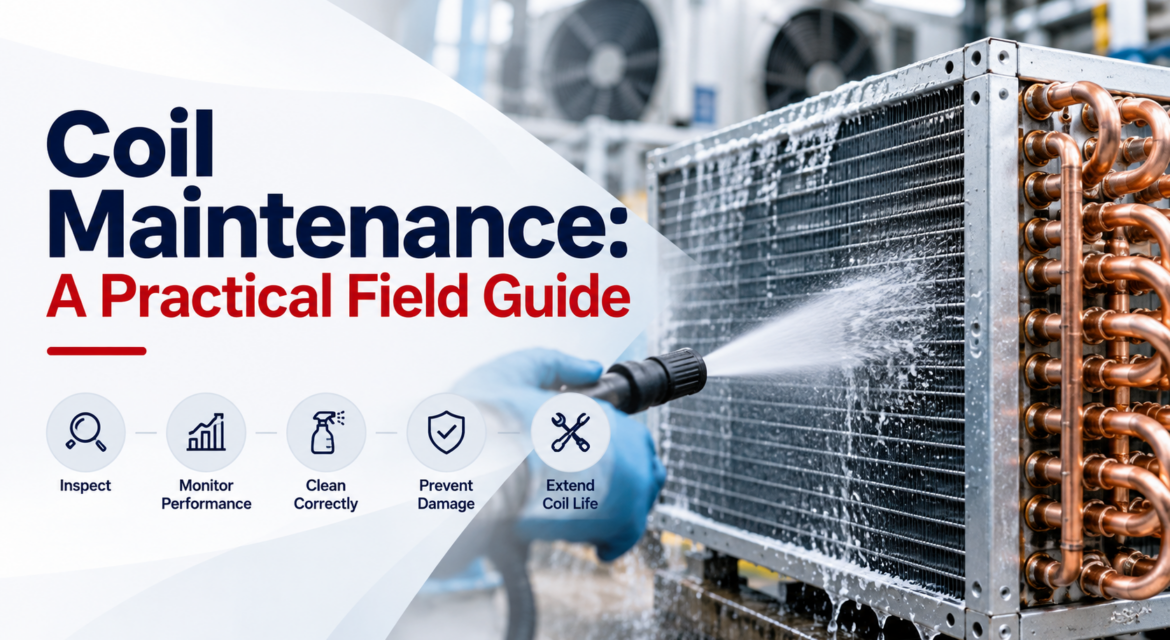
Most coil maintenance advice amounts to “clean it regularly.” That is correct and nearly useless, because it
does not say how often, by what method, or how to tell whether it worked.
This guide is written for the person who actually has to do it.
How Often
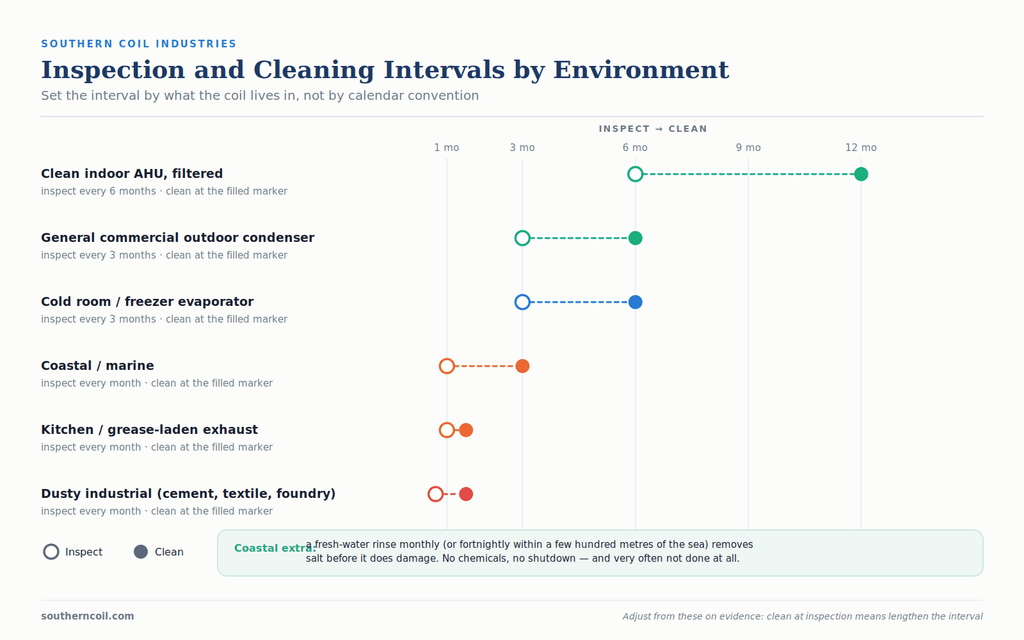
Inspection interval should be set by environment, not by calendar convention. These are working starting
points, adjusted by what you find:
| Environment | Inspection | Typical cleaning |
| Clean indoor AHU, filtered | 6 months | Annually |
| General commercial outdoor condenser | 3 months | 6–12 months |
| Coastal / marine | 1 month | 3–6 months, plus fresh-water rinse |
| Dusty industrial (cement, textile, foundry, mining) | 2–4 weeks | 1–3 months |
| Kitchen / grease-laden exhaust | 1 month | 1–3 months |
| Cold room / freezer evaporator | 3 months | 6 months, plus defrost check |
| Food processing / washdown | Per hygiene schedule | Per hygiene schedule |
Adjust from these on evidence. If a coil is visibly clean at the scheduled cleaning, lengthen the interval. If it is
heavily loaded, shorten it. The point of inspecting more often than you clean is to learn the right interval for
that specific installation
The Measurement That Tells You Everything
Log air-side pressure drop across the coil, and the approach temperature, from the day of commissioning.
Those two numbers, trended over time, will tell you a coil is fouling long before it becomes visible and long
before anyone complains about capacity. Rising pressure drop at constant fan speed means the air path is
closing. A widening approach — the gap between the fluid temperature and the leaving air temperature —
means heat transfer is degrading.
Without a commissioning baseline, neither number means anything. Record them when the coil is new. This
single habit is worth more than any amount of scheduled cleaning, and it costs nothing.
Cleaning: Method Depends on the Coating
This is the section that matters most, and the one most commonly got wrong. Using the wrong chemical or
the wrong pressure on a coated coil destroys the protection you paid for.
| Coil type | Suitable method | Avoid |
| Bare aluminium fin, copper tube | Low-pressure water, pH-neutral coil cleaner, soft brush | Strong alkaline cleaners — they attack aluminium; high-pressure jets |
| Pre-coated / hydrophilic fin | Low-pressure water, neutral cleaner only | Any solvent, any abrasive, anything that strips the coating |
| E-coated (epoxy electrocoat) | Water, neutral or mild alkaline cleaner, moderate pressure | High-pressure jets at close range; harsh solvents |
| Phenolic / baked coating | Per coating manufacturer’s instruction — usually neutral cleaner | Anything not explicitly approved by the coating supplier |
| Copper fin | Water, neutral cleaner | Ammonia-based cleaners — they cause stress corrosion cracking in copper |
| Stainless framed food-service coil | Approved food-grade sanitiser per hygiene protocol | Chlorine-based cleaners on stainless where specified against |
Universal rules regardless of coil type:
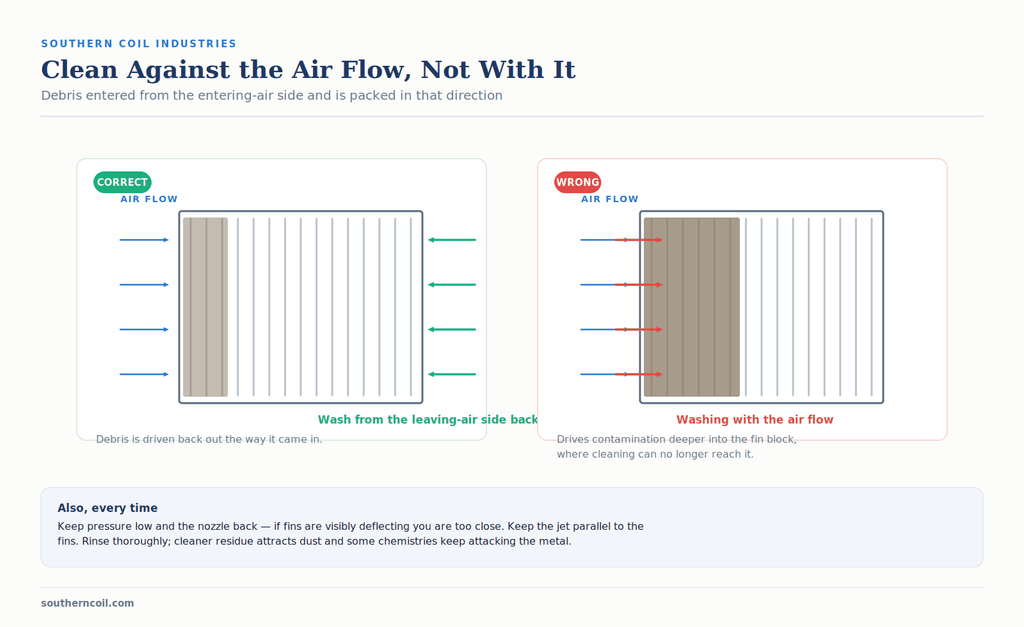
- Blow or wash from the leaving-air side back towards the entering-air side. Debris entered from the
entering-air side and is packed in that direction. Cleaning with the air flow drives it deeper into the fin
block instead of out of it. - Keep pressure low and the nozzle back. A pressure washer held close will lay the fins flat, and flattened
fins block air more thoroughly than the dirt you removed. If you can see fins deflecting, you are too
close or too high. - Keep the jet parallel to the fins, never angled across them.
- Rinse thoroughly. Cleaner residue left on the fin attracts and holds dust, and some chemistries continue
to attack the metal after they have done their job. - When in doubt about a chemical, ask the coil manufacturer. They know what the fin stock and coating
will tolerate.
The Ten-Point Inspection
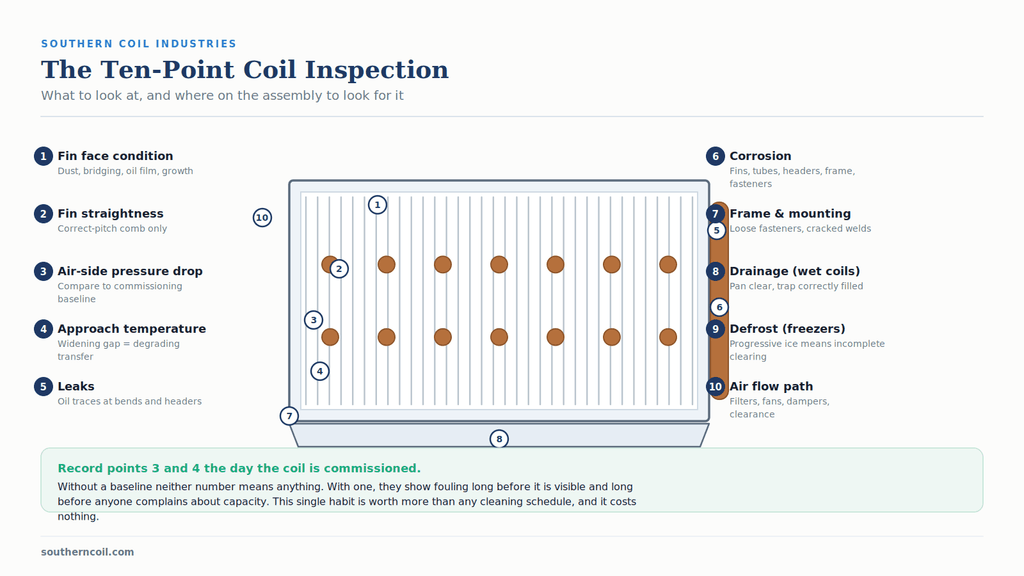
- Fin face condition. Look for dust loading, bridging between fins, oil or grease films, biological growth.
Check the full face, not just the accessible corner — loading is usually uneven. - Fin straightness. Bent fins from hail, handling, transport or over-aggressive cleaning. A fin comb of the
correct FPI will restore them — using the wrong pitch comb causes more damage than it repairs. Work gently;
fin stock is typically 0.1 mm or thinner. - Air-side pressure drop. Measure and compare to baseline.
- Approach temperature. Measure and compare to baseline.
- Leaks. Look for oil traces at return bends, headers and joints — refrigerant leaks carry oil, and the oil stain
remains after the refrigerant has gone. Check corrosion pits, particularly at fin-tube interfaces and where
dissimilar metals meet. - Corrosion. Inspect the fin block, tubes, headers, frame, mounting brackets and fasteners separately.
Frames and fasteners commonly fail before the fin block. White powdery deposit on aluminium is oxidation;
green on copper is corrosion product; rust streaking from a frame indicates the coating has been breached. - Frame and mounting. Loose fasteners, cracked welds, sagging support. A coil that is allowed to vibrate will
eventually crack a joint. - Drainage (wet coils). Drain pan clear, trap correctly filled and correctly sized, no standing water. A dry or
incorrectly sized trap on a negative-pressure AHU pulls air backwards up the drain and prevents condensate
leaving — the pan overflows even though nothing is blocked. - Defrost (freezer coils). Verify defrost is initiating and terminating correctly, heaters are functioning, and no
ice is building progressively cycle over cycle. Progressive ice accumulation means the defrost is not fully
clearing and the coil will eventually block solid. - Air flow path. Filters, fan condition, belt tension, damper position, and — for outdoor condensers —
clearance. Check that discharge air is not being drawn back into the inlet, which is one of the most common
causes of poor condenser performance and has nothing to do with the coil.
Coastal Installations Need One Extra Thing
Salt deposits are hygroscopic — they hold moisture against the metal surface continuously, which is why
coastal corrosion proceeds so much faster than the salt quantity would suggest.
A fresh-water rinse at a much shorter interval than full cleaning — monthly, sometimes fortnightly within a
few hundred metres of the coast — removes the salt before it can do sustained damage. It requires no
chemicals and no shutdown. It is the single highest-value maintenance action for a coastal coil, and it is very
often not done at all.
| Symptom | Likely causes, in order of probability |
| Gradual capacity loss | Fouling; reduced air flow; fin damage |
| Sudden capacity loss | Refrigerant loss; fan failure; blocked filter; control fault |
| Rising discharge pressure | Fouled condenser; reduced condenser air flow; air recirculation; non-condensables in system |
| Ice on evaporator | Low air flow; low refrigerant charge; defrost failure; fin spacing too tight for the duty |
| Water carry-over into duct | Face velocity too high; fin bridging with condensate; drain trap fault |
| Rising fan power at same duty | Progressive fouling |
| Coil never reached rated capacity from day one | Circuiting or distribution problem; poor tube expansion; incorrect selection — not a maintenance issue |
That last row is worth noting. If a coil has never performed, no amount of maintenance will fix it. That is a
design, selection or manufacturing issue, and it needs to be raised with the supplier rather than absorbed into
the maintenance schedule.
When to Replace Rather Than Maintain
Replace when:
- Corrosion has penetrated tube walls, or leaks are recurring in different locations
- Fin loss is extensive enough that surface area is materially reduced
- Fouling is packed deep in the block and cleaning no longer restores baseline pressure drop
- The fin-to-tube bond has degraded through corrosion at the interface
- The load has changed and the coil is now the wrong size
- Cumulative repair cost is approaching replacement cost
A replacement is also the moment to correct any original specification error. If the coil fouled repeatedly
because the fin density was too high for the environment, replacing it with an identical coil guarantees a
repeat. Specify the replacement for the conditions you have actually observed over the coil’s life — that
information is more valuable than the original design brief. See Article 8.
Need a replacement coil, or advice on whether yours is worth keeping?
Send Southern Coil Industries the dimensions, a photograph and what you have observed. We manufacture replacement fin-and-tube coils built to the original envelope, with the specification corrected for the environment.