Most guidance on choosing a manufacturer is written by manufacturers, and it shows. The criteria always
turn out to be the ones the author happens to satisfy.
This one is written to be useful even if you buy from someone else. The questions below are the ones that
actually separate a capable coil supplier from a fabricator with a fin press, and several of them are questions
Southern Coil has to answer as carefully as anyone.
What Actually Varies Between Manufacturers
The fin-and-tube coil is a mature product. Nobody has a secret. What varies is not the concept but the
execution, and execution varies in six specific places:
- Whether they design the coil or just build to your drawing
- Whether their tooling covers the geometry you need
- What happens at the expansion and brazing stages
- What they test, at what pressure, on how many units
- Whether they can repeat the same coil in eighteen months
- What they do when a coil fails in the field
Everything below is a way of finding out about one of those six.
Design Capability: Do They Engineer, or Only Fabricate?
There is a real distinction between a manufacturer who takes your operating conditions and produces a coil
design, and one who takes your drawing and produces exactly what the drawing says.
Both are legitimate businesses. But if you provide a duty and conditions rather than a finished drawing, you
need the first kind — and the way to find out is to give them the conditions and see what comes back.
Ask:
- If I give you duty, fluid, temperatures, airflow and envelope, will you propose rows, circuiting and fin
density, or do you need me to specify them? - What selection or rating method do you use?
- If my requested configuration will not achieve the stated duty, will you tell me before or after
manufacture?
That last question is more revealing than it sounds. A manufacturer who will build a coil they know is
undersized because the customer asked for it is telling you something about how the relationship will go.
Tooling and Range: Can They Actually Build What You Need?
A manufacturer’s real capability is defined by their tooling, and tooling is expensive and specific. Fin dies exist
for particular fin geometries at particular densities on particular tube patterns. If your requirement falls
outside what they hold, the answer is either a tooling charge, a long lead time, or a quiet substitution to
whatever they do have.
Ask for the actual range, in numbers:
- Which tube diameters, and plain or inner-grooved?
- What fin density range, minimum to maximum?
- Which fin geometries — flat, wavy, louvred?
- What is the largest and smallest coil you can build?
- Which frame materials?
- What is the maximum number of rows?
The answers should be specific. “We can do anything” is not an answer; it means either the range is
undefined or the work is being subcontracted
For reference, Southern Coil’s published range is 7 mm and 3/8″ tube in plain and inner-grooved plus 1/2″ plain; fin
densities from 4 to 17 FPI; straight-edge, zig-zag and louvred fin geometry; plain and hydrophilic aluminium fin;
galvanised iron, aluminium, stainless steel and plastic frames; and coil sizes from 6 inches to 6 metres and beyond.
Manufacturing Process: Where Coils Actually Go Wrong
Field failures in fin-and-tube coils cluster in a small number of places, and all of them are process controls
rather than design decisions.
Tube expansion. After the tube is threaded through the fin pack it is expanded to make mechanical and
thermal contact with the fin collar. Under-expand it and there is an air gap at every fin — the coil loses heat
transfer performance invisibly, and no test will catch it. Over-expand it and the tube wall thins and the fin
collar deforms. This single step probably accounts for more quiet underperformance than any other, because
unlike a leak it produces no symptom that points at the coil.
Ask: How is expansion controlled and verified? Mechanical or hydraulic?
Brazing. Every joint, return bend, header connection and distributor tube is a potential leak path. Joint quality
depends on cleanliness, filler selection, heat control and operator skill.
Ask: Is brazing done under nitrogen purge? How are brazers qualified?
Nitrogen purging during brazing prevents copper oxide scale forming inside the tube. That scale later breaks
free and circulates, and it is a well-known cause of expansion valve and compressor problems that get
attributed to everything except the coil that shed the debris.
Fin damage and handling. Coils get bent in handling, packing and transport. Ask how coils are protected in
transit and what the packing standard is for the size you are ordering — a 6-metre coil is not shipped the way
a 600 mm one is.
Testing: The Questions With Numbers in Them
This is where vague answers are least acceptable, and where you should insist on specifics.
Ask:
- What is the leak test pressure, and what medium?
- Is testing 100% of production or sampled? If sampled, at what rate?
- Is burst or proof pressure testing done, and on what basis?
- Do I get a test certificate with the coil?
- What is the test pressure relative to my design working pressure?
That final question is the one that matters and the one rarely asked. A test pressure is only meaningful
relative to the pressure the coil will see in service. A coil tested to 600 psi is comfortably proven for an R134a
or R404A duty; for R410A or R32, where design pressures are substantially higher, you need to confirm the
test pressure still provides adequate margin. Ask the manufacturer to state the test pressure for your
refrigerant, not in general.
Southern Coil leak tests 100% of production with nitrogen. The standard test pressure is 600 psi, raised where the
application’s working and maximum pressure require it — so the test is matched to the duty rather than fixed at a house
limit. Burst pressure testing is carried out periodically on samples and when qualifying new material or a new supplier.
Repeatability: The OEM Question
For an OEM buying the same coil across a production run and across years, consistency matters more than
any single coil’s performance. A coil that varies batch to batch turns into warranty claims, line rejections and
field failures that are impossible to diagnose.
Ask:
- Are drawings and specifications retained and version-controlled?
- If I reorder in two years, will I get an identical coil?
- What is the change-notification process if you alter a material or a process?
- How is incoming material verified?
- Is there traceability from finished coil back to material batch?
The change-notification question is the important one. A manufacturer who quietly switches fin stock
supplier or changes a braze alloy without telling you has introduced an uncontrolled variable into your
product.
Capacity and Delivery
Quality is necessary but not sufficient. A perfect coil that arrives three weeks after your assembly line needed
it has failed.
Ask:
- What is the current lead time for a first article, and for repeat orders?
- What is your monthly capacity in the size range I need?
- How do you handle a schedule change or an urgent requirement?
- What is your on-time delivery performance? (Ask for a number. The answer, or the absence of one, is
informative.)
What Happens When Something Goes Wrong
Every manufacturer will supply a coil that fails eventually. What distinguishes them is what happens next.
Ask:
- What is the warranty, and what specifically does it cover?
- Who determines whether a failure is a manufacturing defect or an application issue?
- Will you carry out a failure analysis?
- What is the turnaround on a warranty replacement?
Ask for a reference from a customer who had a problem, not one who did not. Any manufacturer can produce
a satisfied customer from an order that went smoothly.
The Site Visit
If the coil is going into critical equipment or a long-term OEM programme, visit the plant. An hour on the floor
tells you more than any amount of correspondence.
Look for: how material is stored and identified; whether work in progress is traceable; the condition of the
expansion and brazing stations; whether the test station is in use and records are being filled in as work
proceeds rather than at the end of the shift; how finished coils are protected; and whether the people doing
the work can explain what they are checking for.
What Not to Decide On
Price alone. The coil is typically a small fraction of the installed cost of the system it goes into and a large
fraction of the risk. A cheaper coil that underperforms by 10% costs more in the first year of operation than
the saving.
Certification alone. ISO 9001 certification means a documented quality management system exists and is
audited. It is a meaningful baseline. It is not a statement about coil performance, and it does not distinguish
between manufacturers who all hold it. (Southern Coil operates an ISO 9001:2015-certified quality system.
Size alone. A larger manufacturer has more capacity and more process maturity. A smaller one is more likely
to take on an awkward one-off, engage directly on a design problem, and answer the phone. Which matters
more depends entirely on what you are buying.
The Short Version
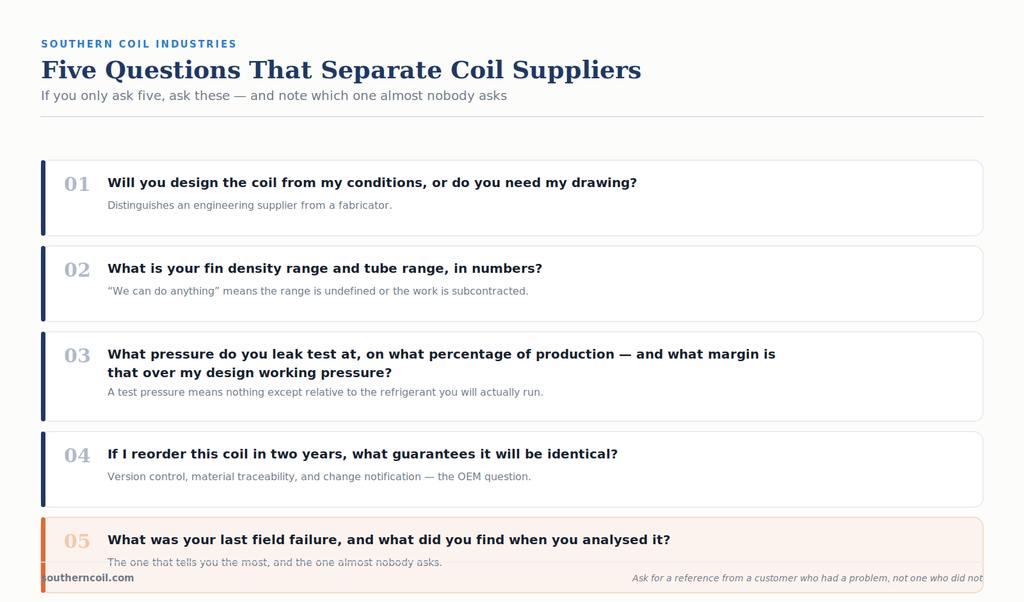
The fifth question is the one that tells you the most, and it is the one almost nobody asks.
Southern Coil Industries has manufactured customised fin-and-tube heat exchangers in Sriperumbudur since
1994, supplying OEMs and end users across industrial, refrigeration, air conditioning and specialised
applications. We are happy to answer every question on this page — including the fifth one.