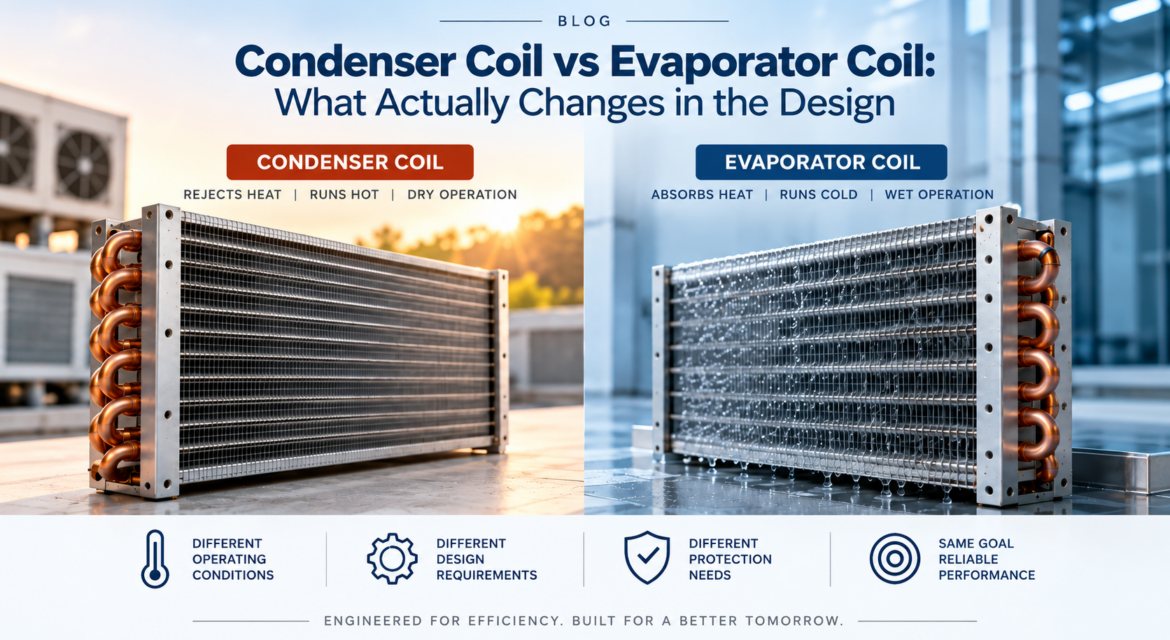
Condenser and evaporator coils are often described as doing opposite jobs in the refrigeration cycle — one
rejects heat, the other absorbs it. That is accurate, and it is also where most explanations stop.
For anyone specifying or buying a coil, the useful question is different: given that they do opposite jobs, what
actually changes in how they are built? The answer affects fin geometry, fin density, drainage, coating,
circuiting and materials — and getting it wrong produces a coil that works on paper and fails in service.
The Basic Difference
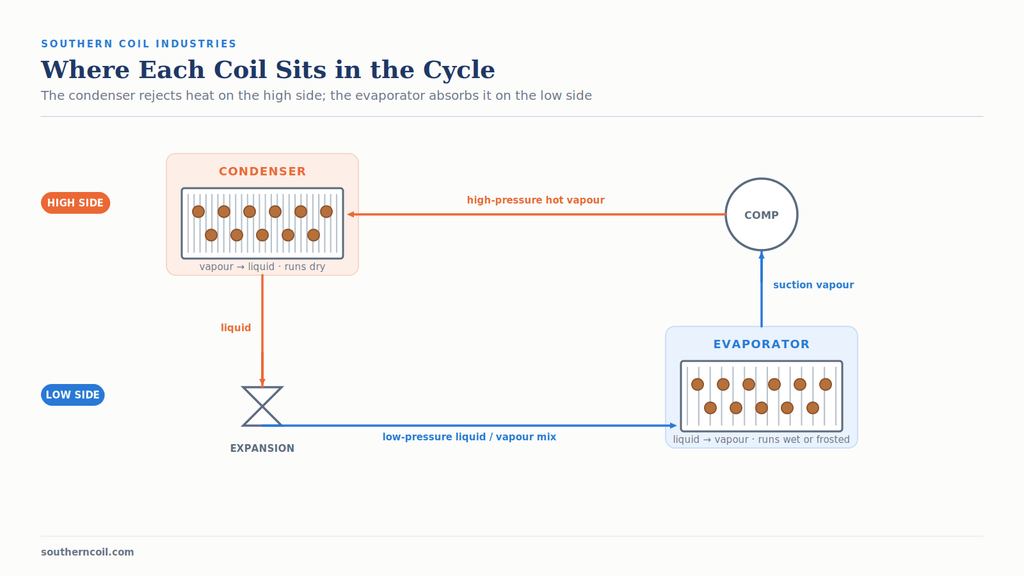
The condenser coil rejects heat. High-pressure, high-temperature refrigerant vapour leaves the compressor,
enters the condenser, gives up heat to ambient air, and condenses to a liquid. It runs hot — typically 10 to 20
K above ambient — and it runs dry.
The evaporator coil absorbs heat. Low-pressure liquid refrigerant enters after the expansion device, absorbs
heat from the air or fluid being cooled, and boils to vapour. It runs cold — below the space temperature —
and, if it runs below the dew point of the entering air, it runs wet.
| Parameter | Condenser coil | Evaporator coil |
| Function | Rejects heat | Absorbs heat |
| Refrigerant state | Vapour → liquid | Liquid → vapour |
| Position in cycle | After compressor | After expansion device |
| Operating pressure | High side | Low side |
| Surface condition | Dry | Wet, or frosted below 0°C |
| Typical temperature | Above ambient | Below space temperature |
| Design driver | Heat rejection at peak ambient | Capacity and moisture handling |
Where the Design Genuinely Diverges
Wet versus dry changes everything on the air side
This is the most consequential difference and the one most often overlooked.
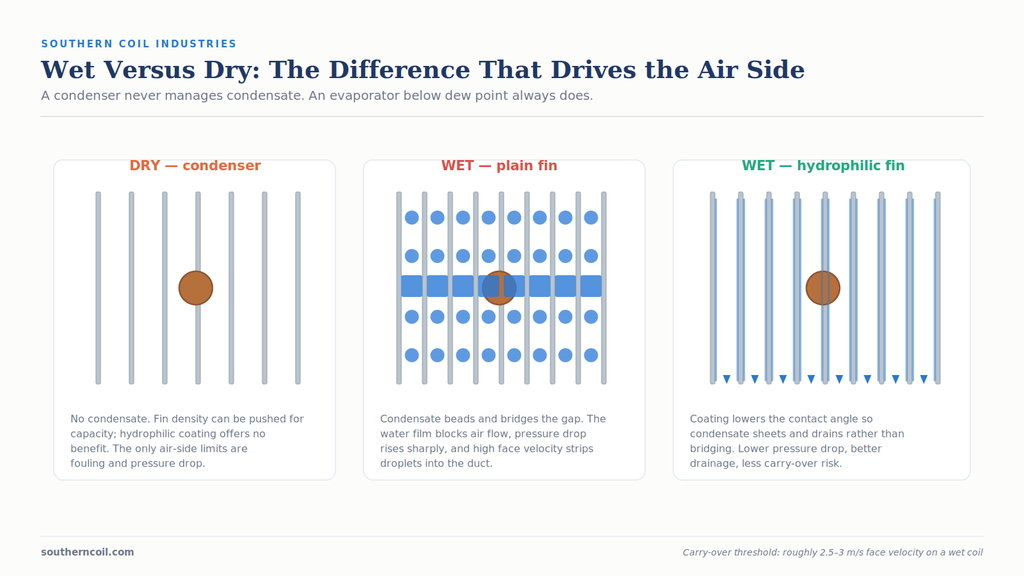
A condenser is dry. There is no condensate, so fin density can be pushed higher without drainage concerns,
hydrophilic coating offers no benefit, and the only air-side limit is fouling and pressure drop.
An evaporator running below dew point is wet. Condensate forms on every fin surface and must drain against
the air stream. That imposes three constraints a condenser never faces:
- Fin density must allow drainage. Water bridging between closely spaced wet fins forms a film thatblocks air flow and raises pressure drop dramatically. Densities appropriate for a dry condenser can beunusable on a wet coil.
- Face velocity must stay below carry-over threshold, typically around 2.5 to 3 m/s, or condensate isstripped off the fins and carried into the duct.
- Hydrophilic fin coating becomes genuinely useful, because it makes condensate sheet and drain ratherthan bead and bridge. On a condenser it is close to pointless
Below freezing, the evaporator has a problem the condenser never has
Any evaporator operating below 0°C accumulates frost. Frost is an insulator and a flow blockage
simultaneously — it degrades heat transfer and chokes the air path at the same time
This is why low-temperature evaporator coils use dramatically wider fin spacing than any condenser would. A
blast freezer coil at 4 to 6 FPI looks absurdly sparse next to a 14 FPI condenser, but it is sized to hold a
workable run time between defrost cycles. The defrost method — electric, hot gas, or off-cycle — also has to
be designed into the coil, not added afterwards.
A condenser never frosts. The design question does not arise.
They fail in different places, so they get protected differently
Condensers usually sit outdoors. They see UV, rain, wind-borne dust, salt in coastal locations and industrial
pollutants. Their failure mode is external corrosion of the fin block and frame, and their protection strategy is
coating and material selection for the outdoor environment.
Evaporators usually sit indoors, inside the cooled space or in an air handler. They see whatever is in the
process air — food acids in a cold room, cleaning chemicals in a washdown area, salt in a fish processing plant
— and they are permanently wet, which accelerates everything. Their failure mode is corrosion driven by the
process environment and constant condensate, and their protection strategy centres on coating chemistry
compatible with wet service and, frequently, stainless steel framing for hygiene.
The same coating is not automatically right for both. A hydrophobic e-coat that performs excellently on a
coastal condenser is the wrong choice for an evaporator that needs to drain.
Circuiting is driven by opposite concerns
In a condenser, the refrigerant enters as superheated vapour and leaves as subcooled liquid. Volume falls
sharply through the coil, so circuiting is designed to maintain sensible velocity as the refrigerant condenses.
In an evaporator, the opposite happens — liquid enters and vapour leaves, volume increases sharply, and
circuiting must maintain enough velocity at the outlet to return oil to the compressor without generating
excessive pressure drop. This is why evaporators use distributors to feed multiple parallel circuits evenly;
uneven distribution starves some circuits and floods others, and the coil never reaches rated capacity.
The Practical Consequence
The most common specification error is treating a coil as a generic block of surface area and asking for “a coil”
of a given capacity and size.
A 20 kW coil designed as a condenser and a 20 kW coil designed as an evaporator are not interchangeable
products. Fin density, fin coating, circuiting, distributor arrangement, drain provision, defrost provision and
material selection all differ. Fitting one where the other belongs produces a coil that either underperforms
immediately or fails early.
When you enquire, say which it is — and if it is an evaporator, say whether it will run wet, and whether it will
run below freezing. Those two answers change more of the design than the capacity does
Common Applications
Condenser coils: air-cooled condensing units, air dryers, process chillers, heat pumps in cooling mode,
refrigeration racks, condensing units for cold rooms.
Evaporator coils: cold room and cold storage units, blast and deep freezers, food display counters, AHU
cooling coils, climate control chambers, water coolers, dehumidifiers.
Southern Coil manufactures both across all of these applications, including deep freezer evaporator coils, cold
room evaporators, coils for food display counters, condensers for air dryers and heat exchangers for process
chillers and heat pumps
Specifying a condenser or evaporator coil?
Tell Southern Coil Industries which side of the cycle it sits on, what it runs at, and where it will be installed — and we will design around it.